
You Can’t Stop Aging — But You Can Control How You Age: Nourishing the Body God Designed
- ketogenicfasting

- Jan 24
- 6 min read
“Aging well is not about chasing youth — it’s about honoring the body God crafted with intention and care.”
Aging is a blessing, but premature aging is not. As a chef who works every day with healing ingredients, I’ve learned that how we hydrate, eat, move, rest, and think directly determines how gracefully we age. When we nourish the body God designed with intention, the body responds with clarity, strength, peace, and renewed vitality.
Below is your blueprint for aging with grace, strength, and far fewer self-inflicted challenges.
1. Hydrate — Consistently and Intentionally
Hydration is one of the simplest, most powerful anti-aging habits. Water supports digestion, circulation, cognition, energy, and youthful skin.
Daily hydration target:
Women: 2.2–2.7 liters (9–11 cups)
Men: 3.0–3.7 liters (12–15 cups)
Or: drink half your body weight in ounces daily.
Hydrate effectively:
Sip 4–8 oz every 30–60 minutes
Avoid chugging
At high altitudes, add +1 liter/day

Learn more; read these blog posts:
2. Eat Antioxidants — Let Food Protect Your Cells
Oxidative stress accelerates aging. Antioxidants slow it down.
Rich antioxidant sources:
Blueberries
Cacao nibs
Dark chocolate chips (used in Býli Bowls)
Green tea
Deeply colored vegetables such as:
Red cabbage
Purple kale
Rainbow chard
Cooked spinach (raw spinach = very high oxalate source)

Learn more; read these blog posts:
3. Radically Reduce Sugar — Slow Down Glycation, Slow Down Aging
Sugar is one of the fastest ways to age the body. It stiffens collagen, inflames tissues, disrupts hormones, and accelerates cellular wear.
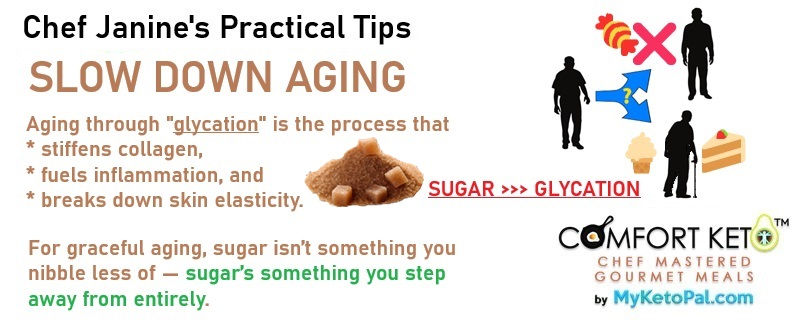
Recipes aligned with the ketogenic lifestyle naturally remove sugar from the daily diet and use low-carb or no-carb sweetener alternatives made from natural, sugar-free sources.
Healthy sweeteners:
Xylitol
Erythritol
Stevia
Monk fruit
Allulose (excellent for blood sugar regulation)
All Comfort Keto meals and Býli Bowls use monk fruit only — sweetness should heal, not harm.
Learn more; read these blog posts:
To understand glycation with scientific clarity, this peer-reviewed review article from Biophysical Reviews (2024) offers one of the most reliable explanations available. It breaks down what glycation is at the molecular level, how it alters proteins, and why these changes contribute to aging, inflammation, and metabolic diseases. The article also explores the formation of AGEs (advanced glycation end products) and outlines current research on how to reduce or inhibit glycation in the body.
➡️ Read the full scientific overview on "Glycation" here: https://www.ncbi.nlm.nih.gov/pmc/articles/PMC11078917/
4. Prioritize Sleep — Your Nightly Repair Cycle
Sleep is where deep restoration occurs. Adults need 7–9 hours; older adults often thrive with 7–8.
Healthy sleep habits:
Turn off electronics 30–60 minutes before bed (not only for blue light — but to reduce visual overstimulation)
Enjoy a handful of pistachios an hour before bed for natural melatonin support
Avoid full meals within 2 hours of bedtime
Sip water lightly
Read something calming — reading lowers cortisol and gently prepares the mind for rest
If hungry an hour before going to bed, choose a light, low-carb snack like nuts, yogurt, or broth.

“Evenings should be the soft landing zone of the day — gentle, calm, and unhurried.”
Learn more; read these blog posts:
5. Move Daily — Preserve Muscle, Protect Balance, Protect Youth
Adults lose 3–8% of muscle per decade, faster after 50 — especially in the legs and hips. Weak legs = compromised balance, slower metabolism, and faster aging.
But muscle can be rebuilt at any age with 10–15 minutes/day.
Minimum effective daily movements:
Squats / chair squats — 8–12 reps
Step-ups — 6–10 per leg
Glute bridges — 10–12
Calf raises — 12–15
Countertop or wall push-ups — 8–12
Plank — 15–20 seconds
Balance essentials
Just 1–2 minutes/day:
Stand on one leg
Heel-to-toe walking
Sit-to-stand without hands
Gentle weight shifting
Early morning workouts
Training at 5–6 am is excellent.
A 5–10 minute dry sauna beforehand warms muscles and reduces injury risk.
Gym option (optional)
20–30 minutes is enough:
Leg press
Chest press
Row machine
Plank
Recovery
A 10–15 minute steam sauna or warm Epsom-salt pool relaxes muscles, eases stiffness, supports magnesium absorption, and activates the body’s “rest and repair” mode.
Walking: the quiet longevity tool
Three 10-minute walks or 7,000–10,000 steps/day support metabolic flexibility, heart health, and mental clarity.
“Movement doesn’t need to be long or complex — just regular and intentional.”
6. Manage Stress — Peace Is a Nutrient
Chronic stress accelerates aging at the cellular level. When stress hits, the body enters fight-or-flight:
Inside the stress response
Adrenaline spikes (rapid heart rate, muscle tension)
Cortisol rises (keeps you reactive for hours)
The prefrontal cortex — logic, empathy, good decision-making — temporarily shuts down
This is why people misinterpret, overreact, or make poor decisions under stress.
Cortisol timeline
60–90 minutes to reduce by half
3–5 hours to return to baseline
Protect mornings & evenings
Morning (6–8am): cortisol is naturally highest → avoid arguments, bad news, heavy conversation
Evening: cortisol blocks melatonin → avoid stress before bed
How to return to peace
Prayer — the most powerful emotional regulator; restores humility, safety, and calm
Breathwork — lowers heart rate & cortisol within minutes
Reading — activates the thinking brain and calms intrusive thoughts
Journaling — offloads tension and organizes emotions
“Stress ages the body. Peace restores it. And peaceful habits create peaceful sleep.”
7. Embrace Healthy Fats — Nourish Skin, Brain, and Hormones
Healthy fats stabilize hormones, fuel the brain, hydrate the skin, and lower inflammation.
Skin
Healthy fats strengthen cell membranes.Beef tallow is uniquely bioavailable for topical use — it mirrors human skin lipids, deeply hydrates, seals moisture, and supports repair.
Omega-3s: brain’s anti-aging foundation
DHA & EPA:
reduce inflammation
support memory & learning
stabilize mood
improve neurotransmitters
protect neurons
support long-term cognition
Cholesterol: essential for brain & hormones
The brain contains 20–25% of the body’s cholesterol.
Needed for:
neuron formation
synapses
nerve insulation
mood regulation
hormone production
The liver makes ~1–1.2 g/day, but extra dietary cholesterol is crucial during stress, aging, healing, ketosis, and inflammation.
Best sources
Pasture-raised egg yolks
Grass-fed butter, cream, ghee
Beef tallow
Grass-fed beef
Liver and organ meats
Grass-fed full-fat cheeses
A clear note on vegan diets
Animal nutrients like cholesterol, DHA, B12, choline, taurine, creatine, and retinol are essential for cognitive and emotional stability.
Strict vegan diets often lack these, which can lead to:
reduced cognitive sharpness
mood instability
irritability
anxiety or depression
emotional volatility
brain fog
These effects are physiological, not personal. When the brain is undernourished, mood and cognition suffer.
Avoid these fats
Industrial seed oils accelerate aging: canola, corn, soybean, cottonseed, vegetable oil blends.
These oils act like internal rust accelerators.
8. Support Gut Health — Your Inner Ecosystem
A strong gut supports immunity, hormone balance, nutrient absorption, inflammation control, mood stability, and overall vitality.Your microbiome needs both probiotics and prebiotics.
Probiotics — the beneficial living bacteria
Probiotics introduce good microbes into the gut and support digestion, mood, immunity, and reduced inflammation.
Found in naturally fermented and cultured foods such as:
Grass-fed cultured cream
Chia cultured cream
Greek yogurt
Sauerkraut and fermented vegetables
Kimchi
Raw apple cider vinegar
Coconut aminos
Cultured cheeses
Prebiotics — the fibers that feed good bacteria
Prebiotics help probiotics thrive, multiply, and strengthen the gut ecosystem.
Common prebiotic-rich foods include:
Chia seeds
Garlic, onions, leeks, scallions
Broccoli, cabbage, cauliflower, Brussels sprouts
Pumpkin seeds, almonds, walnuts, coconut
Berries (blueberries, strawberries, blackberries, raspberries)
Jicama, ginger, radishes
Herbs and spices like parsley, dill, basil, oregano, cinnamon
These ingredients appear regularly throughout my Comfort Keto weekly menus and Býli Bowls — foods I use every week and always — because they nourish the gut, calm inflammation, and support vibrant health.
Aging Gracefully Is a Daily Recipe
When you:
hydrate intentionally
embrace antioxidants
radically reduce sugar
sleep deeply
move regularly
protect your peace
enjoy whole healthy fats
support your gut
…you’re not stopping aging —you’re choosing to age with strength, clarity, vitality, and grace, just as God designed.



Comments